
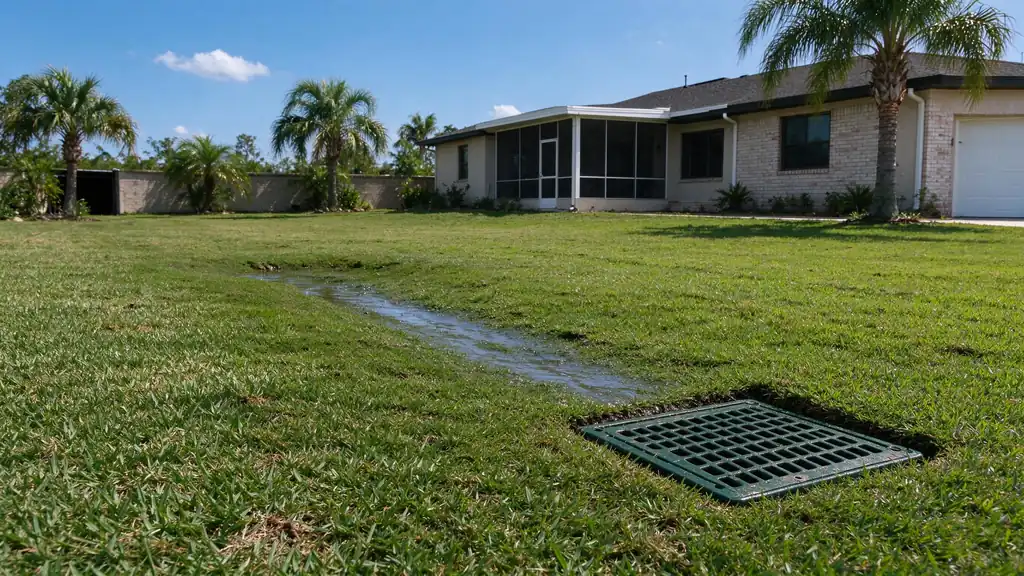
A useful drainage plan follows water from its source to a receiving point that can accept it. Choose surface or subsurface collection after checking the ground, elevations, access and outlet. A drain can address a private property defect; it cannot guarantee protection when coastal water or a wider public system controls the receiving level.
Quay Corpus Christi Drainage offers private-property drainage work for homes and commercial sites in Corpus Christi. Use this guide to understand the choices behind an assessment or estimate. You do not need to identify the correct product before asking for help, and a photograph of standing water does not establish which installation will work.
Identify the water before choosing the collector
Start with the source and timing. Roof runoff often arrives at concentrated discharge points. Paving contributes surface flow. Water can approach from higher neighboring ground, accumulate in a low lawn or move through shallow soil. Irrigation and leaking supply pipes can create a wet area even without rainfall; wastewater is a separate scope that needs the appropriate provider.
Observe from a safe location during and after rain. Record where water enters, where it stands and where it normally leaves. Include visible downspouts, paving edges, grates and recent landscape changes. Do not remove covers in flowing water, enter chambers or walk through water to obtain a better photograph.
The standing-water guide explains how to build a useful record. Compare it with the stormwater-versus-sewer guide when the source is unclear. Appearance, odor or one wet patch is information to report, not a reliable diagnosis by itself.
Establish a receiving route early
A collector only starts the water path. The plan also needs a conveyance route and a receiving point, with usable elevations between them. A proposed outlet may appear nearby while still being too high, blocked, submerged during rain or subject to restrictions on a connection.
Think in terms of the entire route. An uphill pipe section can retain water. A receiving ditch or system that backs up can control discharge even when the buried line is clear. More inlets increase collection opportunities but do not automatically increase what the downstream route can accept.
Ask which observations or measurements establish a feasible outlet and what happens when the collection capacity is exceeded. Our no-gravity-outlet guide discusses conditional alternatives without assuming a pump or dry well is appropriate. A deeper trench alone does not create a usable discharge elevation.
Match collection to the water layer
Surface water and water moving within soil reach a collector differently. A catch basin receives water through a grate at a point on the surface. A channel drain intercepts flow along a linear opening, often beside a driveway or patio. Their placement should follow the actual surface flow and the finished levels around them.
A French drain uses a permeable collection zone around a perforated pipe. It can intercept subsurface movement, but water crossing paving may never reach that zone quickly enough. A surface inlet and subsurface trench are therefore not interchangeable ways to solve every puddle.
The French-versus-surface comparison helps identify the correct layer. Where both layers matter, a combined arrangement can make sense if its collection functions, pipe connections and outlet are deliberately defined. Avoid buying a method first and searching for a justification afterward.
Understand catch basins, channels and grading
A catch basin needs more than a grate at the lowest visible spot. The approach surface must deliver water to it, the grate must suit the setting and the basin needs accessible space for debris. An apparently clean grate does not establish that the pipe leaving the basin is clear.
A channel drain can intercept water before it crosses a garage opening or hardscape edge. Vehicle loading, grate removal, concrete support and the surrounding surface finish affect its suitability. Retrofitting one through paving can involve a different project from placing a collector during new construction.
Grading or a shallow swale can redirect surface flow where room and receiving levels allow. The changed surface must rejoin untouched ground without trapping water or transferring the problem onto another property. Compare grading and swales with catch-basin installation and channel drains before assuming a buried pipe is always required.
Give each pipe a defined function
Perforated pipe admits water along a collection zone. Solid pipe conveys water between points without intentionally releasing it along that route. A system may use both, but the change in function should be visible in the scope. The pipe-selection guide explains why “drain pipe” is not a complete specification.
Material and assembly choices also affect maintenance. Corrugated and smooth-wall products have different connection, bend and cleaning considerations. Specify the intended assembly, support and access according to the selected product and site rather than treating material names as a promise of performance.
PVC is one smooth-wall pipe option, available in assemblies intended for different collection or conveyance duties. Specify the actual pipe and compatible fittings, not just the material name. Rigid sections still need suitable support and an installation that preserves the intended fall.
A pop-up emitter is a discharge component, not a substitute for evaluating the receiving area. It must be able to release water where the ground, access and approvals allow. Keep the outlet visible and serviceable; burying it under soil or planting can interrupt a route that previously worked.
Check soil and infiltration rather than assuming it
Infiltration depends on how readily the receiving ground accepts water and on the space available before the ground becomes saturated. A dry well provides storage while water moves into surrounding soil. A rain garden uses a shallow planted area as part of a surface-water strategy. Neither creates unlimited disposal capacity.
Ground layers can change with depth. A sandy surface does not prove that the layer beneath a proposed installation drains quickly, and compacted soil can behave differently from nearby undisturbed ground. Groundwater conditions and separation from buildings or other features also belong in the assessment.
The dry-well and rain-garden guide treats these as conditional choices. Ask what testing supports the proposal, how much water it is intended to receive and where overflow will go. Do not equate a larger hole or more stone with a demonstrated infiltration solution.
Size the decision before specifying capacity
Drainage area, surface type and rainfall intensity affect the water reaching a collector. A roof discharging into one downspout can concentrate water differently from a lawn receiving the same rainfall. Impervious paving also changes the amount and speed of runoff compared with ground that can absorb some water.
Collection openings, pipe capacity, fall, bends and receiving conditions work together. Choosing a larger grate does not resolve a restricted pipe, and choosing a larger pipe does not establish an authorized outlet. A product’s capacity information needs to be used within a site-specific arrangement, not copied as a guarantee for the whole property.
For a proposal, ask what area contributes water and which conditions the layout addresses. Quay’s inspection scope is the route for discussing unresolved water-path questions. Detailed engineering or public-system design is a separate scope when the project requires it.
Get an Estimate
Tell us what happens, where the property is and what access or outlet information you have. A request does not confirm an appointment or price.
Keep Corpus Christi’s local differences in the plan
The FEMA flood insurance study describes generally flat areas and differing drainage patterns across Corpus Christi. That context makes receiving levels and overland paths worth checking; it does not establish one soil type or one drain design for the entire city.
A property in Flour Bluff raises different ground-layer and receiving-basin questions from a project in North Beach. Portland brings a different municipal jurisdiction. A location name helps frame the investigation, but the actual parcel and proposed change determine what needs confirmation.
Avoid treating an area label, house age or nearby ditch as evidence that a particular property’s drainage is defective. Ask for the finding that connects the local context to the proposed work. That keeps the estimate tied to a demonstrated decision rather than a generic coastal-yard package.
Separate private work from public approvals
Before proposing a curb cut, street connection or excavation near a public drainage area, identify the responsible authority and the public/private boundary. A private contractor’s proposal does not grant permission to use a public receiving system or change a right of way.
Corpus Christi’s construction stormwater guidance addresses authorization for groundwater discharged during excavation. That is a separate issue from choosing the permanent outlet for ordinary yard runoff. Keep temporary construction arrangements and the final system’s approvals distinct.
The permits-and-outlets guide covers the questions to confirm for grading, qualifying development and receiving routes. The actual process and documentation depend on the scope. Do not apply every development requirement to a small repair or assume that private property means no approval is needed.
Plan excavation and the finish together
Access can change the method. Gate width, nearby equipment, fences, mature planting and finished paving affect how excavation reaches the route and where soil can be staged. Identify public utility notification and private-line locating responsibilities before the work begins. Do not probe for an unknown line yourself.
The installation scope should describe the collection zone, pipe connections, support and cleaning access. Ask how the work will be checked before backfill hides it. A limited flow observation can confirm a particular condition; it is not proof of performance during every rainfall or elevated receiving-water event.
Restoration deserves a written description. Establish what happens to surplus soil, turf, planting beds, concrete and disturbed irrigation. The installation-and-restoration guide connects those handoffs so the estimate describes a finished improvement, not just the material placed underground.
Diagnose an existing failure by its part of the route
Water can fail to enter a collection zone, encounter sediment in a basin, meet damaged or obstructed pipe, stop at an uphill section or back up from the receiving point. Those are different failures. Replacing the most visible component does not necessarily correct the limiting condition.
For a French drain, check the intended collection area as well as the pipe and outlet. Filter or aggregate problems concern entry into the system. A crushed conveyance section concerns travel through it. A submerged outlet concerns receiving conditions outside the collector. Each finding points toward a different repair decision.
See why French drains stop working and yard-system repair. Ask what supports cleaning, a localized correction or replacement. A new system should not be proposed merely because the existing one is old or because one rainfall left the lawn wet.
Build maintenance access into the original scope
A serviceable arrangement keeps grates, basin interiors, cleanouts and the receiving point identifiable and accessible. Record their locations before planting or turf covers the work. Follow the selected product’s instructions rather than improvising high-pressure cleaning on an unknown line.
From a safe place after rain, note changes in the flow pattern and whether water remains above a collector. Keep loose leaves away from grates and avoid raising soil or mulch over an outlet. Repeated restriction, damaged components or recurring backup calls for investigation rather than an endless cycle of clearing the same grate.
The maintenance guide separates accessible upkeep from inspection work. Maintenance is part of the installation decision: a route that cannot be reached later can turn a small obstruction into unnecessary excavation.
Compare price against the complete purpose
The cost guide uses national budgeting context for two evidenced work categories and specific cost drivers for other services. It does not present a verified Corpus Christi installed-price average. Depth, access, materials, outlet requirements and restoration can change what a proposal actually includes.
Ask for the source, collection method, conveyance route, receiving point and overflow expectation in the same written scope. Then compare approvals, testing, disposal, surface repair and maintenance access. Mark allowances and exclusions so two totals can be compared on equal terms.
The estimate checklist is useful whether the next step is installation, repair or further assessment. Insurance or incentive eligibility should be confirmed for the actual circumstances; no installation rebate or coverage payment is assumed here.
Recognize what a lot drain cannot promise
A blocked private inlet can be a correctable collection problem. Raised coastal water or a wider public-system restriction is a different receiving condition. Adding another collector cannot lower the water outside the property, and Quay does not promise protection from storm surge or every flooding event.
The coastal-flooding comparison helps set that boundary. Likewise, sanitary sewer work, structural foundation repair and municipal civil works are outside this site’s offered drainage scope. A useful assessment makes the handoff clear when a different authority or provider is needed.
To discuss private water management, request an estimate with the address, water timing and any known collection or outlet. The sensible next move is to establish what the property needs, then choose a method whose complete route and limits can be explained.