
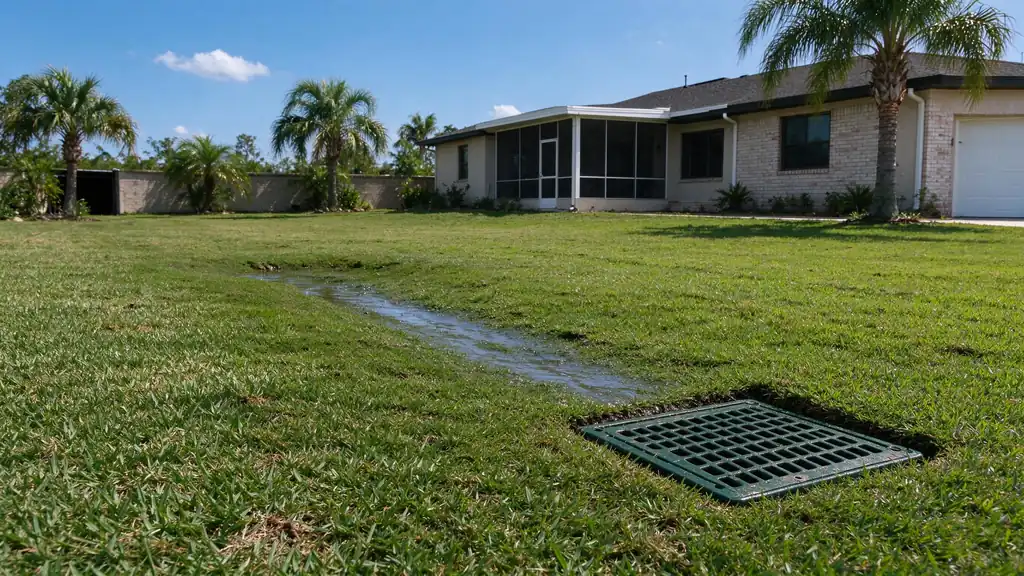
Choose drainage work by the part of the water route that needs attention. Quay offers private-property assessment, installation and repair in Corpus Christi, including selected commercial properties. Surface collection, subsurface collection, conveyance and receiving conditions are related, but they are not interchangeable services. A useful request can begin with the situation rather than a product name.
This directory explains where each service fits. If the source or existing route is unknown, start with an assessment instead of committing to a trench type. The complete drainage guide provides the wider framework, while the service-area hub explains local decisions that can change the receiving or approval questions.
Understand the problem before selecting installation
Drainage inspections focus on observations, sources, levels, existing routes and limits. Share rain timing, dry-weather water, prior changes and accessible records. The agreed inspection methods should be explicit; camera work or destructive opening is not assumed in every request. Findings should distinguish what is measured from what remains concealed.
Drainage repair addresses an identified failure in collection, conveyance or discharge. Cleaning, a local damaged section and wider replacement are different responses. A clear pipe can still be limited by poor fall or receiving-water backup. Repeated trouble should be investigated rather than automatically answered with another collector or a full replacement.
Receive runoff moving across the surface
Yard drainage considers the whole private landscape route, including where roof, paving and ground contributions meet. The service can coordinate different methods when the property needs them, but each collector still needs a receiving purpose. A puddle location alone does not define the appropriate installation.
Catch basin installation receives runoff at a point reached by surrounding levels. Grate support, loading, sediment storage and connected pipe are part of the decision. A clear basin placed outside the water path will not necessarily receive it. Cleaning access should remain practical after the landscape returns.
Channel drain installation intercepts water along a line, often where runoff crosses hardscape. The grate, body, base and supporting construction must suit the actual use. A channel’s visible length is not its whole installation scope; connections, outlet and restoration remain essential.
Change the surface route or coordinate hardscape
Grading and swales change how water moves across ground. The project should measure existing and receiving levels, rejoin unchanged surfaces and consider historical shared flow. Added fill is not automatically a solution if it creates another ridge or transfers water to a neighboring area.
Driveway and patio drainage compares interception, surface changes and the interfaces with paving. A drainage retrofit does not automatically include a new uniform driveway finish. For new construction, establish finished levels, receiver and contractor responsibilities before paving fixes those conditions.
Receive soil water and manage roof discharge
French drain installation concerns a permeable collection zone within the ground. Filter, aggregate, pipe and soil compatibility affect entry and performance. It is not interchangeable with a surface grate. The method comparison explains how to choose by water layer.
Foundation drainage addresses water routing around a building while keeping structural repair and other building defects separate. An exterior drain is not a structural certification or a guarantee of a dry interior. Source, excavation constraints and receiving conditions need a defined scope.
Downspout drainage carries concentrated roof water beyond the gutter system. New gutter installation is excluded. Solid conveyance, accessible transitions and a suitable receiver should be identified so collected roof water is not released unintentionally into ground beside the original problem.
Plan private commercial work around operation
Commercial drainage considers private collection and conveyance alongside loading, occupied access, staging, utilities and maintenance responsibilities. Public infrastructure and municipal civil construction are excluded. Disturbance, right-of-way and construction discharge questions should be checked for the actual project rather than copied indiscriminately from a different development type.
The permit guide and installation guide help define those interfaces. A contractor proposal should identify what stays usable, who restores each surface and what documentation is supplied. No unsupported completion time or uninterrupted-access promise is inferred from the service label.
Compare the complete purpose and finish
The cost guide retains limited national budgeting evidence and explains where local price bands are not established. Use the estimate checklist to compare collection, route, outlet, approvals, checks and restoration. A cheaper visible component may omit essential work beyond it.
To request an estimate, describe the property, water behavior, known existing drains and access constraints through the shared form. You can select the closest situation without diagnosing the system. Accepted submission confirms receipt only; scope, appointment, price and authorization require separate arrangement.