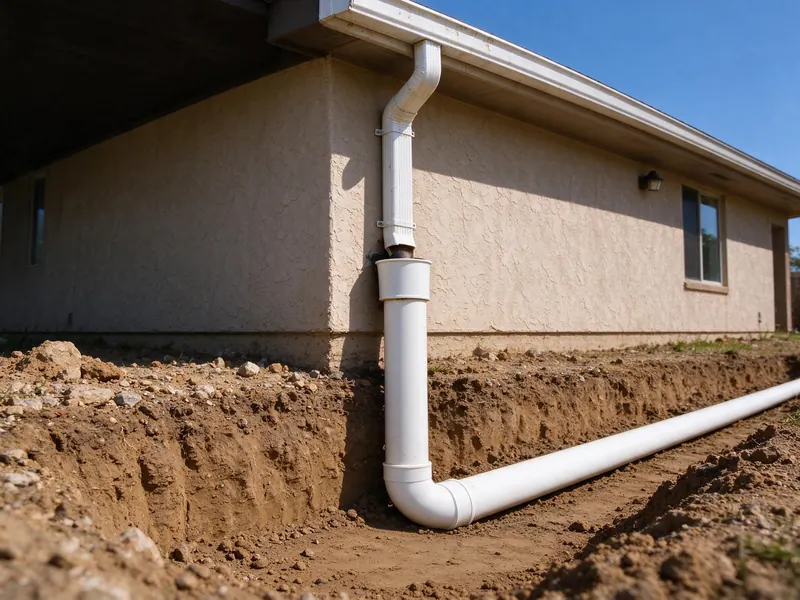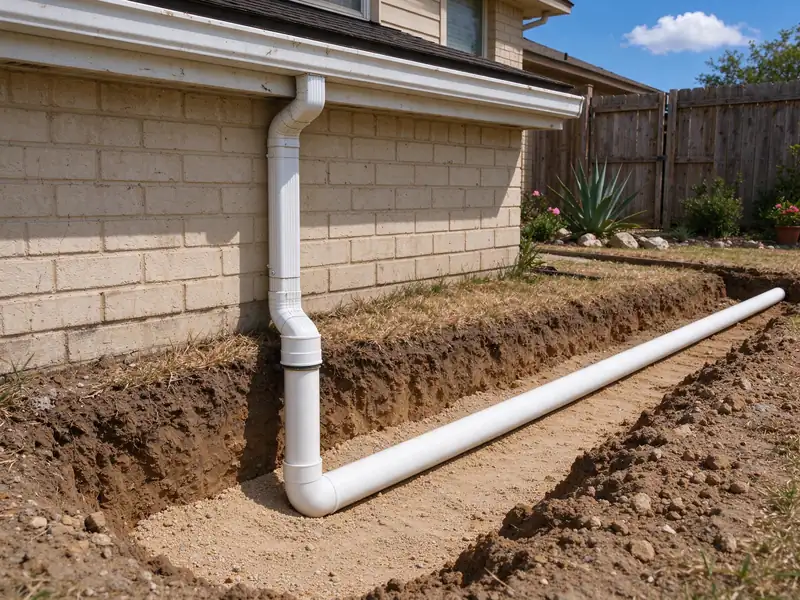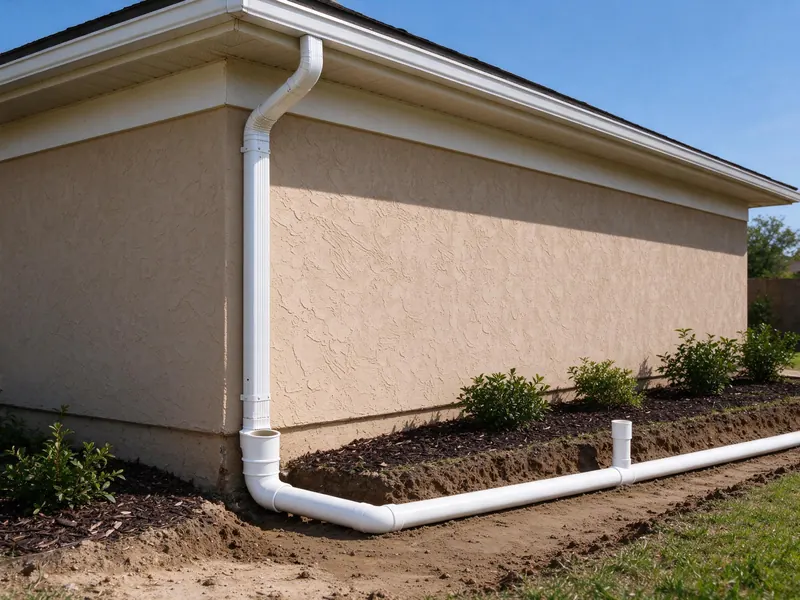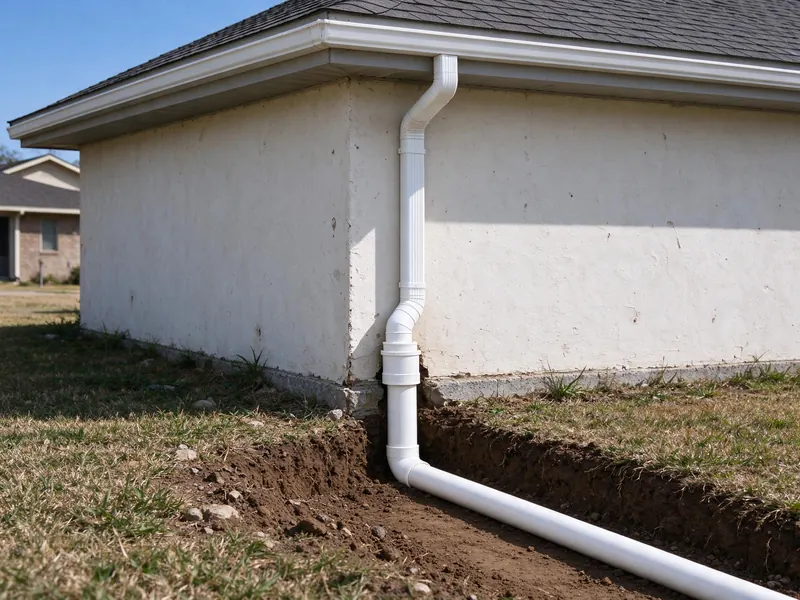
Downspout drainage concerns where roof water goes after it leaves the gutter system. Quay offers private-property drainage connections in Corpus Christi that carry concentrated roof runoff along an identified receiving route. The work should distinguish a faulty gutter, an unsuitable discharge location and a blocked or damaged buried line. Each can produce water near the house, but they are different problems.
The proposal should explain the connection at the downspout, the function of the buried pipe, its cleaning access and where it ends. New gutter installation is outside this drainage scope. If water is spilling over the roof edge before reaching a downspout, that upstream issue needs its appropriate trade rather than an assumption that a new underground line will correct it.
Observe the roof outlet and nearby ground separately
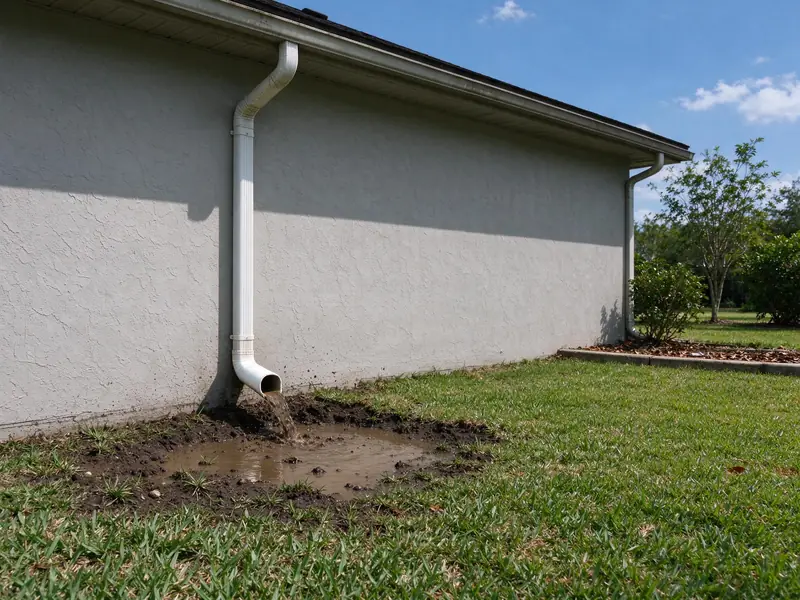
Record whether water overflows from above, escapes at a visible joint or discharges normally and then gathers on the ground. Describe whether the problem appears at one downspout or several. A photograph of water beside the wall is useful context, but it does not establish which part failed. Safe observations can help an assessment avoid replacing sound pipe while leaving a gutter defect unresolved.
The ground receiving the roof water also matters. A short extension may simply transfer runoff into a low lawn, across a walking route or toward a boundary. The standing-water guide helps record what happens after discharge. Keep observations separate from conclusions about foundation movement, leaks or other building problems that require their own assessment.
Trace a continuous receiving route
Concentrated roof water needs somewhere appropriate to go. Establish the available elevations from the downspout connection through the proposed conveyance to its receiving point. A line should not be described only by its first section beside the house. Crossings, changes of direction and the final connection can determine whether it empties as intended.
An outlet may behave differently during the rain that causes the problem. If its receiving level rises, a clear line can still back up. Read the no-gravity-outlet guide when comparing a buried extension with other options. Avoid assuming that a nearby street inlet, curb or neighboring drain is available for a private connection simply because it appears convenient.
Keep roof-water conveyance distinct from collection trenches
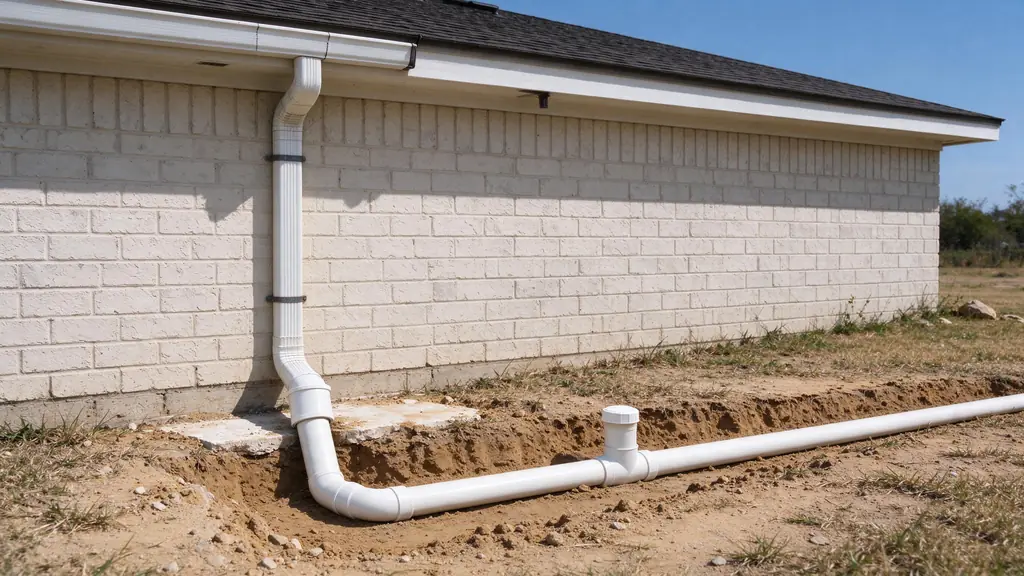
Solid pipe carries collected roof water along a defined route. Perforated pipe receives water through its surrounding ground. Connecting a downspout into perforated pipe without considering that distinction can release roof runoff into soil close to the area the project is intended to protect. The proposal should identify where each function begins and ends.
A French drain may be appropriate elsewhere on the property for a soil-water problem, but it is not automatically the preferred connection for a downspout. The pipe comparison explains the mechanism, and the French drain service describes the permeable trench. Combined systems need deliberate routing and suitable connections rather than a general instruction to join every drain together.
Design connections that can be inspected and cleaned
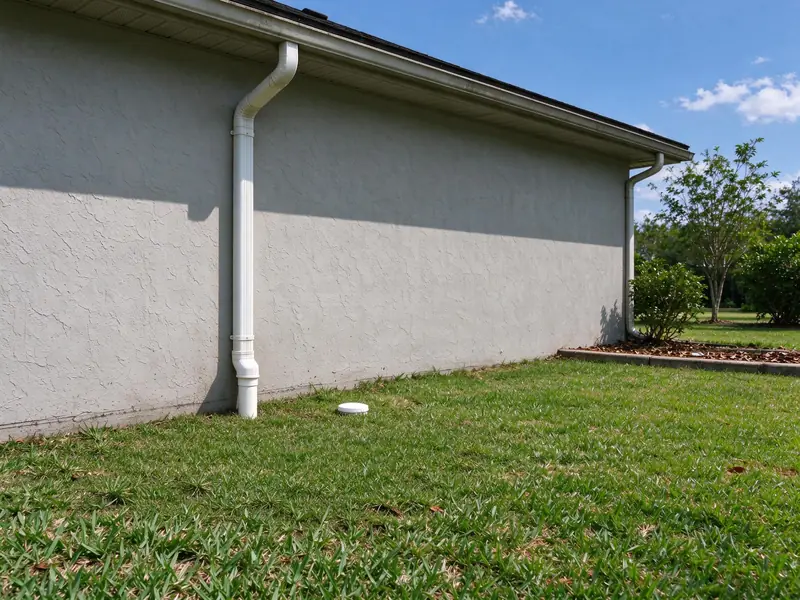
The transition from the visible downspout to underground pipe should suit the arrangement, keep unwanted debris out where appropriate and preserve a means of maintenance. Leaves and roof debris can reach a buried route. A system with no practical cleaning access can turn a small restriction into excavation. Ask how the connection is opened and which parts are intended to remain visible.
Bends, junctions and changes in pipe type affect access farther along the line. Record their locations rather than relying on memory after landscaping returns. If several downspouts join one route, identify those connections and consider the shared outlet. The maintenance guide covers safe surface checks, while drainage inspections can address an unknown existing line.
Avoid creating another concentrated discharge problem
Moving roof runoff away from one wall is only part of the decision. The receiving location should not depend on concentrating water beside another building, at a neighboring boundary or across a frequently used path. Existing drainage easements and historical flow may affect the available route. Those are reasons to examine the destination before settling the trench alignment.
The neighbor-runoff guide explains how to document cross-boundary flow without treating a site observation as a legal conclusion. Where a connection or excavation touches public right-of-way, consult the permit and outlet guide. The permanent roof-water route and any temporary construction dewatering are separate decisions and should not be confused in the scope.
Plan trenching around the property in use
A roof outlet may sit in a narrow side yard, beside a gate, through a planting bed or near fixed equipment. Those conditions influence excavation and the ability to achieve a continuous route. Public utility location does not necessarily identify every private irrigation, lighting or building connection. Share known records and access restrictions before the installation plan is finalized.
Agree on how the line crosses paths, driveways and other hardscape. A buried connection can involve more restoration than its visible starting point suggests. The installation guide helps define spoil handling, backfill and the surface finish. The written proposal should identify whether removed planting, turf, paving and irrigation repairs are included or left for another contractor.
Compare price against the full connection
There is no verified local downspout-drainage installation band here. The number of roof outlets, pipe length, trench depth, bends, access, crossings and final discharge work can all influence the scope. Reusing an existing line may reduce some work only if its route and condition support reuse. An unknown buried connection should not be treated as a confirmed saving.
Use the drainage cost guide for supported budgeting context and the estimate checklist to compare actual proposals. Ask whether each price includes the visible transition, underground conveyance, cleaning access, outlet and agreed restoration. A per-foot pipe figure alone does not describe the whole roof-water connection or guarantee that its receiving point is suitable.
Check performance and keep the route identifiable
A completed connection should be checked for the intended movement of water and visible leaks before inaccessible sections are concealed. A controlled check is useful, but it does not reproduce every roof flow or receiving-water condition. Ask what was checked and what remains dependent on rainfall, public drainage or other conditions beyond the private system.
After installation, keep covers and visible outlets accessible. Watch for changes such as water escaping at the transition, a line that stays full or a discharge point buried by later landscaping. The repair service distinguishes restrictions and damage from outlet backup. To request an estimate, identify the affected roof outlets, any visible overflow and what is known about the existing underground route.