
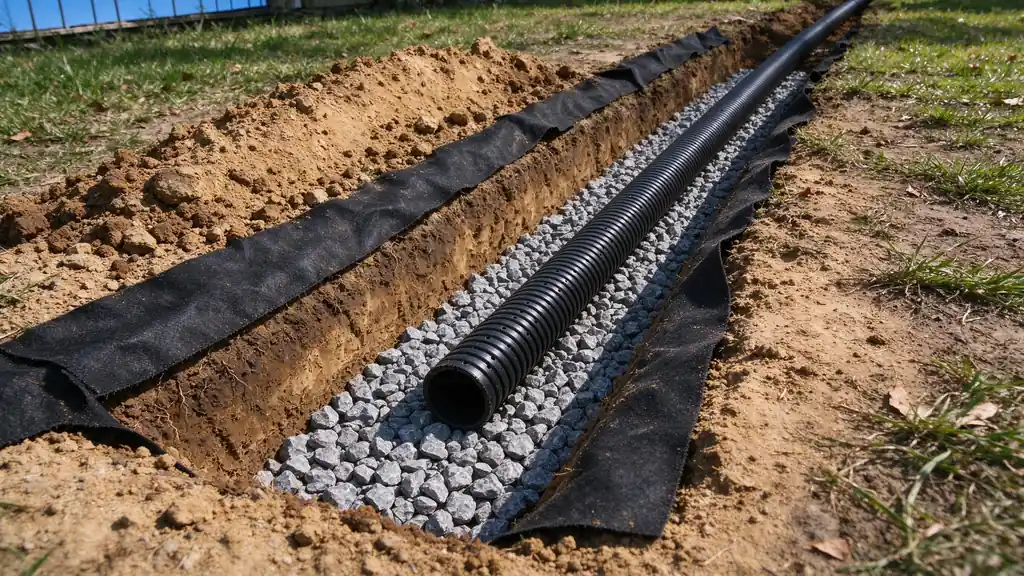
Perforated pipe receives water through a surrounding collection zone; solid pipe carries already-collected water to a receiver. Use each for its defined job. A roof outlet or basin connected to unspecified perforated pipe can release concentrated runoff beside the original problem. Material, joints, fall and maintenance access still matter for either type.
This guide supports downspout drainage and French drain installation. The difference is functional, not simply a choice between two product names. A proposal should show where collection begins and ends, how conveyance continues and which receiving conditions allow the whole route to empty.
Explain the collection zone around perforated pipe
In a French drain, water enters through suitable surrounding material before reaching the pipe. Filter, aggregate and actual soil need to work together. The pipe’s openings alone do not guarantee that the trench receives the relevant water or stays useful. Placement and depth should relate to the observed subsurface path.
The French-drain comparison distinguishes this from fast surface runoff. A buried perforated line may be bypassed by water crossing hardscape. If surface collection is needed, a basin or channel can have a separate job. Do not assume the presence of perforations makes a line suitable for every source on the property.
Carry collected water without unintended release
A downspout, basin or channel has already collected water at an identified point or line. Solid conveyance carries that water onward without intentionally releasing it through openings along the route. This distinction matters near buildings and wet ground where concentrating more water into the surrounding soil may defeat the project’s purpose.
Read catch basin installation and channel installation for those connections. If a proposal combines collectors, ask how transitions are made and which sections remain solid. A general note saying drain pipe is insufficient where the system depends on different sections having different water-entry behavior.
Compare materials and connections by application
Pipe material influences installation support, compatible fittings and the way access is arranged. Product substitutions should be considered against the actual route and manufacturer requirements, not only purchase price. A connection that appears to fit is not necessarily a suitable transition between different components or functions.
Where PVC, corrugated products or proprietary systems are discussed, ask what supports the choice for the setting and how joints are made. This guide does not prescribe a universal material, diameter or joining method. The installation guide helps make the proposed assembly and checks explicit before backfill hides them.
Preserve usable fall along the route
Neither solid nor perforated pipe creates a lower receiving point. The collection level, route and outlet need to work together. Crossings, bends and existing services may constrain the alignment. A deeper excavation can leave less usable fall at the final connection rather than improve discharge.
The no-gravity-outlet guide explains receiving options and limits. Consider the receiver during the rainfall that causes the problem, not only when dry. A clear line can remain full if its receiver rises. Choosing a more expensive pipe material does not by itself change that controlling condition.
Make cleaning access part of the selection
A line needs practical access for appropriate inspection and maintenance. Junctions and changes of direction can influence where that access is useful. Record the route and transitions so later landscaping or paving does not bury them. A system that is easy to draw but difficult to reach can become expensive to investigate when behavior changes.
The maintenance guide and repair service distinguish routine cleaning from damage or unsuitable fall. Cleaning methods should suit the installed material and condition. Do not assume that every private line can be treated with the same equipment or that repeated blockage is proof that the pipe type alone is wrong.
Review reuse and repairs carefully
An existing buried route may be useful, but its destination and condition should not be inferred from one visible opening. Share records and identify what is confirmed. An inspection can state which sections are accessible and where further investigation is needed before reuse or a localized repair is priced.
A repaired section should retain the intended function. Replacing collection pipe with solid pipe can remove a receiving zone; substituting perforated pipe in conveyance can create an unintended discharge. The estimate checklist helps compare those details. The cost guide explains why product price alone cannot represent the full excavation, support, connections, outlet and restoration scope.
Ask for an identifiable installed assembly
Record the proposed material and compatible fittings, not merely a color or nominal pipe size. If a section changes from collection to conveyance, mark that transition in the route information. This makes later repair decisions more useful and reduces the risk that a future substitution changes where water enters or escapes.