
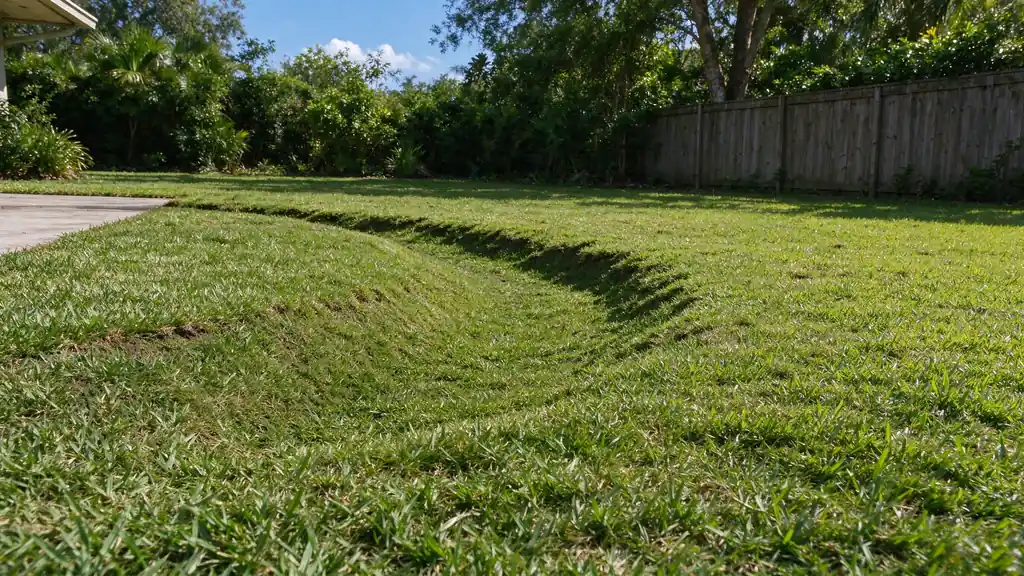
Document runoff crossing a boundary before deciding how to change it. Identify the apparent source, direction, timing and receiving route, then consider easements, historical flow and applicable review. A private drain should not merely transfer the problem downstream. Observing water movement does not establish legal responsibility or permission to alter a neighboring property.
This guide supports yard drainage and grading and swales. It is a practical record and planning guide, not a legal determination. Boundary disputes, easement interpretation and responsibility for damage may need the appropriate professional or authority beyond a private drainage assessment.
Record what can actually be observed
From a safe place on property you are authorized to access, note where water enters, when it appears and which surfaces seem to contribute. Include recent paving, roof-outlet or landscape changes if known. Photographs across stages of rain can show a route more clearly than one image of standing water beside a fence.
Use the standing-water record to separate observations from assumptions. Water near a boundary does not prove that the adjoining owner caused the condition. Surface levels, public receiving water and several private sources can interact. Avoid entering another property, opening its drains or moving a barrier to investigate without appropriate permission.
Identify the existing receiving route
A proposed collector needs somewhere suitable to send water. A line ending near a boundary may concentrate a broad surface flow into a different discharge pattern. A new ridge can also interrupt a historical route and create ponding upstream. Ask how the design changes both incoming and outgoing water, not only how it affects the visible wet patch.
The no-gravity-outlet guide explains the receiving decision. A neighboring drain is not automatically available for connection, even if it appears to have capacity. Ownership, permission, condition and maintenance responsibility need to be established rather than assumed. A private proposal should identify those dependencies clearly.
Bring easement and project information
Share any relevant drainage plans, easement records, surveys or approval documents you already hold. The drainage assessment can use them as context, but their interpretation or completeness may need confirmation. A fence position should not be treated as definitive evidence of every legal boundary or drainage right.
The permit and outlet guide helps identify questions for the actual jurisdiction. Qualifying island development has documented requirements concerning historical neighboring flow and approved discharge. Read the North Padre Island brief where relevant. Those requirements should not be generalized to every yard repair or used as a substitute for determining the actual project’s obligations.
Compare interception with surface changes
A collector placed on your property may intercept a suitable water path, but its type and position depend on the source. A French drain receives water through the ground; a basin or channel receives surface runoff. The collection comparison explains why the method should not be selected solely because the complaint involves a boundary.
Changing surface levels may offer another route, but it can affect incoming flow and downstream discharge. Ask how new ground meets unchanged areas, buildings and shared routes. A proposal that only raises one side without considering the other may leave an unmanaged effect outside the excavated area. Keep the wider path visible when comparing alternatives.
Separate technical findings from legal conclusions
An inspection can identify observed sources, levels, connections and possible work options within its agreed scope. It does not automatically certify who is responsible, whether an easement allows a change or whether another owner must pay. Those are different questions and should be addressed through the appropriate channels.
Written findings should make their limits clear. Distinguish what was measured from what was supplied by an owner or remains concealed. Avoid using a contractor’s preliminary suggestion as proof of legal fault. A clearer technical record can still be valuable for planning without overstating what the assessment establishes.
Define installation and maintenance responsibilities
If an agreed arrangement uses shared access or a connection involving another party, document the relevant permissions and who maintains each part before work. Identify how the route can be cleaned and how future paving or planting may affect it. An installation that depends on access no one can obtain is difficult to maintain reliably.
The installation guide and estimate checklist help define the physical scope. Compare price only after the receiving route and responsibilities are understood. The cost guide does not supply a boundary-dispute allowance or guarantee a particular remedy. Request an assessment with observations and known records, while keeping legal, public-system and private construction decisions distinct.