
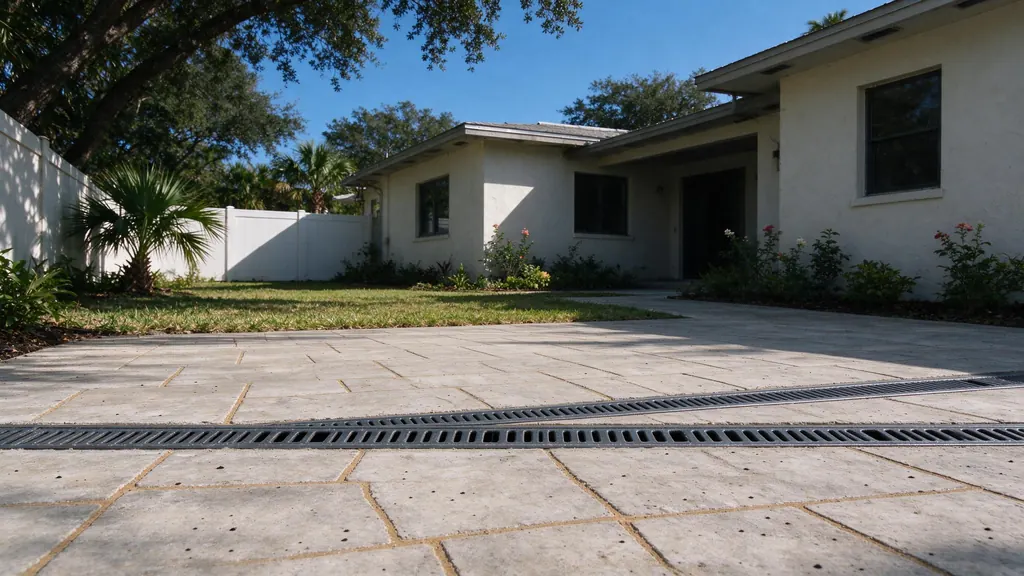
North Beach drainage planning needs a firm distinction between private-lot work and wider coastal or public drainage conditions. Quay offers private-property drainage assessment, installation and repair in Corpus Christi’s North Beach. A useful proposal can identify runoff sources, collection and conveyance on the lot. It should also explain when the receiving water or public system limits what that private work can achieve.
Corpus Christi has identified North Beach among areas receiving flood-response preparation, and public project records describe a North Beach drainage canal with associated road and public improvements. Those records establish an important scope boundary. They do not prove that a particular private parcel has been improved, that a public project is complete or that a new yard drain can guarantee flood protection.
Document the private problem before selecting a remedy
Describe whether water begins on the property, arrives across a boundary or backs up at an existing discharge. Record the timing relative to rain and visible changes in receiving water. Show roof outlets, paved areas and collectors where they can be observed safely. The standing-water guide helps organize those facts without encouraging entry into unsafe water.
Do not infer the source from the place water ends up. A low courtyard may receive several private contributions while also being unable to discharge under wider conditions. An assessment needs to separate those mechanisms. The inspection service can define what is observed, what levels need checking and which conclusions remain uncertain because the route or receiving condition is concealed.
Keep coastal receiving water in the decision
A gravity drain depends on a usable difference between the collection route and its receiver. When the receiving level rises, a clear pipe can lose the ability to empty. Installing another inlet or increasing the collector’s size does not lower that receiving level. A proposed remedy should explain its limits during those conditions rather than presenting every recurrence as an installation defect.
The private-drainage-versus-coastal-flooding guide explains that boundary. A private lot drain is not a storm-surge barrier or a substitute for public safety instructions. Hazardous flooding and public infrastructure concerns require the appropriate authority or emergency response. Estimate requests are not an emergency attendance service, and no after-hours response is promised here.
Distinguish public improvements from work on the lot
A public drainage canal or road project can affect the wider setting without defining an individual property’s authorized connection. Do not assume that a nearby public feature is available as a private discharge point. Its ownership, receiving conditions and connection requirements need to be confirmed for the proposed work. A project record is not permission for a contractor to alter public infrastructure.
Use the permit and outlet guide to identify those questions. Quay’s scope excludes municipal civil construction. A private estimate should clearly identify where its work stops and what depends on a public authority or another project. That is especially useful when a property owner is comparing a small retrofit against a broader public improvement described in local records.
Choose collection for the actual water layer
A point basin receives surface runoff at a location; a channel receives it along a line; a French drain receives water through a permeable trench in the ground. The fact that a property is in North Beach does not decide which method fits. Match the collector to observations and measured levels rather than to a general coastal label.
Compare yard drainage, channel installation and French drain installation as distinct scopes. Roof-water conveyance may need separate attention through downspout drainage. Where several sources join, the final receiving route still needs to be suitable for the combined arrangement. More collection points do not automatically mean more discharge capacity.
Treat infiltration and pumping as conditional options
If a gravity receiver is unavailable or becomes submerged, another method needs its own evidence. Infiltration requires ground that can accept stored water under relevant conditions, with a considered overflow route. A storage structure alone does not make water disappear. Do not assume all coastal sand or imported fill behaves the same way at the proposed installation depth.
Pumping introduces power, equipment, discharge, access and maintenance responsibilities. It is not simply a deeper version of a gravity drain. The no-outlet guide explains those comparisons. Any proposal relying on mechanical discharge should identify what happens during equipment failure or unsuitable receiving conditions without promising universal protection during coastal events.
Confirm approvals and practical access
The applicable Corpus Christi review depends on the actual change: grading, a public connection, right-of-way work or qualifying development are different matters. Temporary groundwater discharge during construction is also separate from the permanent drainage destination. Ask who confirms those requirements before excavation and how the approved arrangement is reflected in the written scope.
Access and restoration should reflect the property’s use, buildings, paving, fixed equipment and private services. Share known records and restrictions. The installation and restoration guide helps define equipment access, spoil handling, backfill and the finish. A private drain should not be planned on the assumption that an unrelated public project will restore the disturbed portion of the lot.
Compare prices for an achievable private scope
Compare the estimate against the actual investigation, receiving route and agreed finish rather than treating a single unit price as the complete project. Collection type, depth, access, pipe route, outlet work, loading and restoration can all affect an estimate. A proposal that depends on unresolved public connection or receiving-water assumptions should make those dependencies clear. Price alone cannot establish whether the chosen route will be usable.
The cost guide retains national service-specific context with limitations. Use the estimate checklist to compare what can be delivered on the property, what remains conditional and how changes are handled. No local rebate, financing, warranty or emergency attendance promise is assumed. Those terms require explicit confirmation rather than being inferred from an installation quote.
Retain the record for future changes
At handover, identify accessible collectors, pipe direction, cleaning points and the agreed receiving route. Keep those details available for later paving or landscaping work. Surface changes can defeat collection even when buried pipe remains intact. The maintenance guide explains safe checks without treating a flooded outlet as something an owner should enter or clear during hazardous conditions.
For an estimate, provide the North Beach property location, observed timing, affected areas, known drainage and the visible receiving context. Nearby Southside uses a different basin-specific brief. A North Beach request should retain its coastal and public-system questions so the proposed private work is evaluated against the conditions that actually control its discharge.